
how to organize blankets and throws in living room usually comes down to one thing: you want them within arm’s reach, but you don’t want your sofa area looking like a laundry basket.
If you’ve ever done a “quick tidy” before guests arrive, you already know the pain point, blankets are bulky, they slide off arms, they attract pet hair, and they multiply fast. The upside is that a few small decisions, where they live, how many stay out, and how they get folded, can make the whole room feel calmer.

This guide stays practical, it helps you pick the right storage method for your space, build a simple “blanket limit,” and set up a system that stays tidy even when you actually use the blankets every day.
Start with a realistic blanket inventory (so storage actually works)
Before buying bins or baskets, count what you’re dealing with. Most living rooms look “messy” not because storage is missing, but because the volume is higher than the storage can handle.
A quick sort that works in many homes:
- Daily-use throws: the ones you reach for on the couch or reading chair.
- Guest + seasonal: extra warm, holiday colors, or the ones that only come out sometimes.
- “I should donate this”: scratchy, shedding, too small, or never used.
If you want a simple rule, keep 2–4 throws visible in the living room in many setups, then store the rest elsewhere. Bigger households may need more, but a limit keeps the room from feeling busy.
Choose the right storage style for your living room layout
Not every storage solution fits every room. A basket can be perfect in one corner and annoying in another. Pick based on foot traffic, seating, and whether kids or pets will treat throws like toys.
Quick comparison table
| Option | Best for | Watch-outs |
|---|---|---|
| Large floor basket | Families, frequent use, relaxed style | Can look overflowing if overfilled; choose taller sides |
| Lidded ottoman | Small rooms, hidden storage, multi-use seating | Blankets can get musty if damp; let them air out |
| Bench with baskets underneath | Open-concept spaces, entry-to-living transitions | Needs “return habit” or baskets become dumping zones |
| Cabinet or credenza shelf | More polished look, less visual clutter | Harder to access, people stop using throws |
| Wall hooks or ladder | Very tight spaces, style-forward rooms | Collects dust; can look messy if too many are hung |
For most living rooms, one “grab spot” near the main seating plus one “backstock spot” somewhere closed works better than trying to make one bin do everything.
Create zones: grab zone, backup zone, and wash zone
If you’re figuring out how to organize blankets and throws in living room and nothing sticks, it’s often because there’s no agreed “home” for each stage of use.
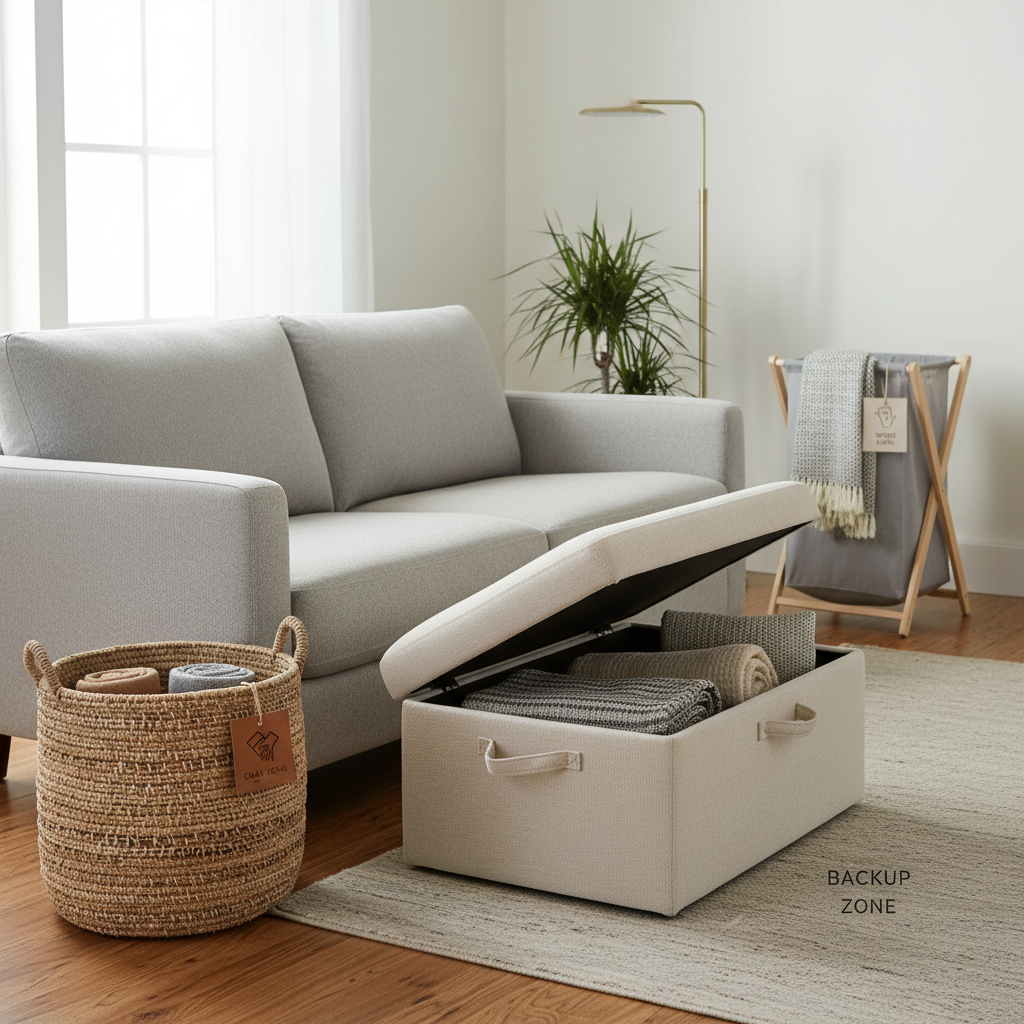
Try this three-zone approach:
- Grab zone: 1 basket, 1 shelf cubby, or 1 ottoman near the couch. Keep only the throws you use weekly.
- Backup zone: a closed cabinet, hall closet, or storage bench for extras and seasonal blankets.
- Wash zone: a small hamper or a dedicated hook so used throws don’t land on the floor or get mixed into “clean” storage.
The wash zone sounds fussy, but it’s the part that prevents the “clean pile vs. not clean pile” problem that makes rooms feel cluttered.
Folding and rolling methods that stay neat (even in a basket)
Baskets fail when everything gets shoved in. The fix isn’t more discipline, it’s a fold that behaves well in the storage you chose.
For baskets: the “soft rectangle” fold
- Fold in half lengthwise.
- Fold again into a wide rectangle, not too tight.
- Stand it vertically like a file folder, so you can grab one without unstacking.
For shelves and cabinets: tight fold or roll
- Tight fold: keeps stacks crisp, best for woven throws and quilts.
- Roll: best for fleece and knit throws that puff up, store rolls side-by-side.
For display (so it looks intentional)
- One drape only on the sofa or chair, avoid multiple layers on the same armrest.
- Choose a throw that matches your room’s dominant color, and let one accent color do the “pop.”
Declutter decisions: how many throws should live in the room?
People rarely want to hear this, but if your living room holds eight blankets, it will usually look like it holds eight blankets. Storage can hide some of it, but the easiest win is deciding what “enough” means.
A practical cap that fits many homes:
- 1 throw per main seating spot you actually use (sofa + favorite chair).
- 1 spare for guests or extra-cold nights.
- Seasonal swaps live in the backup zone, not the living room.
If you have kids, consider an extra “kid blanket” that can take abuse, then the nicer throws stay folded and clean.
Step-by-step setup (30–45 minutes, no shopping required)
If you want a system today, use what you already have and upgrade later. This is where most people finally feel the difference.
- Pick one container for the grab zone: any basket, fabric bin, or ottoman you already own.
- Choose your visible set: pull 2–4 throws you want accessible and that look good together.
- Fold for the container: use vertical folds for baskets, rolls for deep bins.
- Move extras out: relocate seasonal and seldom-used blankets to a closet or cabinet.
- Create a wash cue: a hamper, hook, or even a dedicated chair corner that means “needs washing,” then clear it every week.
Key point: if your basket looks full on day one, it’s already too small for your chosen blanket count, reduce the visible set or switch containers.
Common mistakes that keep blankets messy (and how to avoid them)
A few habits make any setup fall apart. Fixing them is usually easier than buying new furniture.
- Using one basket for everything: it becomes a catch-all, not blanket storage. Keep the grab zone “blankets only.”
- Storing damp or dirty throws: odors and mildew are possible in enclosed storage. Let blankets fully dry after washing.
- Over-styling: three throws draped on one couch reads like clutter, not cozy.
- No return path: if it’s easier to toss a throw on the floor than fold it, the floor wins. Use a bin that accepts imperfect folding.
According to CDC, keeping household textiles clean can help reduce allergens like dust mites, and washing recommendations vary by fabric, so check the care label before choosing a cleaning routine that fits your home.
When to get extra help (or rethink the room)
If you’ve tried a basket and an ottoman and the room still feels chaotic, the issue may not be blankets at all. It’s often overall storage capacity, furniture scale, or traffic flow.
Consider a pro organizer or designer if:
- You have no closed storage anywhere nearby and the room must stay visually minimal.
- All storage doubles as toy storage, pet storage, and mail storage, so blankets never keep a home.
- You suspect mold or persistent odors in stored textiles, in that case, it may be worth consulting a cleaning or indoor air professional for safe next steps.

Sometimes the best fix is simply upgrading one piece, like swapping a tiny basket for a deeper lidded ottoman, so the system matches real life.
Conclusion: keep cozy, lose the clutter
how to organize blankets and throws in living room doesn’t need a complicated method, it needs a clear limit, one easy grab spot, and a place for extras to disappear. Once the room has zones and your folding matches the container, staying tidy becomes the default, not a special event.
If you want a simple next move, pick your grab-zone container today and cap visible throws at four, then re-check in a week and adjust based on what you actually used.
FAQ
What’s the easiest way to store throws on a sofa without looking messy?
Keep a single throw draped or folded on the sofa, and move the rest into a basket or ottoman nearby. More than one on the same armrest often reads as clutter.
How many blankets should I keep in my living room?
In many homes, 2–4 throws in the room feels comfortable without looking overloaded. If you regularly host guests or have kids, you may keep a few more, but store backups out of sight.
Is a blanket ladder practical or just decor?
It can be practical in tight spaces, but it works best for 2–3 lightweight throws. If your blankets are heavy or you live in a dusty area, a closed option may stay cleaner.
How do I organize blankets if I don’t have a closet near the living room?
Use a lidded ottoman or a cabinet/credenza as a backup zone. If you only have open storage, choose matching baskets and keep the visible set smaller.
What’s the best way to keep pet hair off throws in the living room?
Store the nicer throws in closed storage when not in use, and keep one “pet-friendly” blanket accessible. Washing frequency depends on fabric and household needs, check care labels to avoid damage.
Why do my stored blankets smell musty?
Often it’s putting blankets away slightly damp, storing in a low-airflow spot, or using a container that traps humidity. Air them out, confirm they’re fully dry, and consider a more breathable storage option.
How can I make blankets look intentional in my decor?
Pick throws that repeat one or two colors already in the room, then use a consistent fold or drape style. A coordinated “set” looks calmer than a mix of random patterns.
If you’re trying to keep your living room guest-ready without giving up comfort, a simple storage upgrade like a deeper basket or a lidded ottoman can make the whole system easier to maintain, especially when blankets are part of everyday life.